
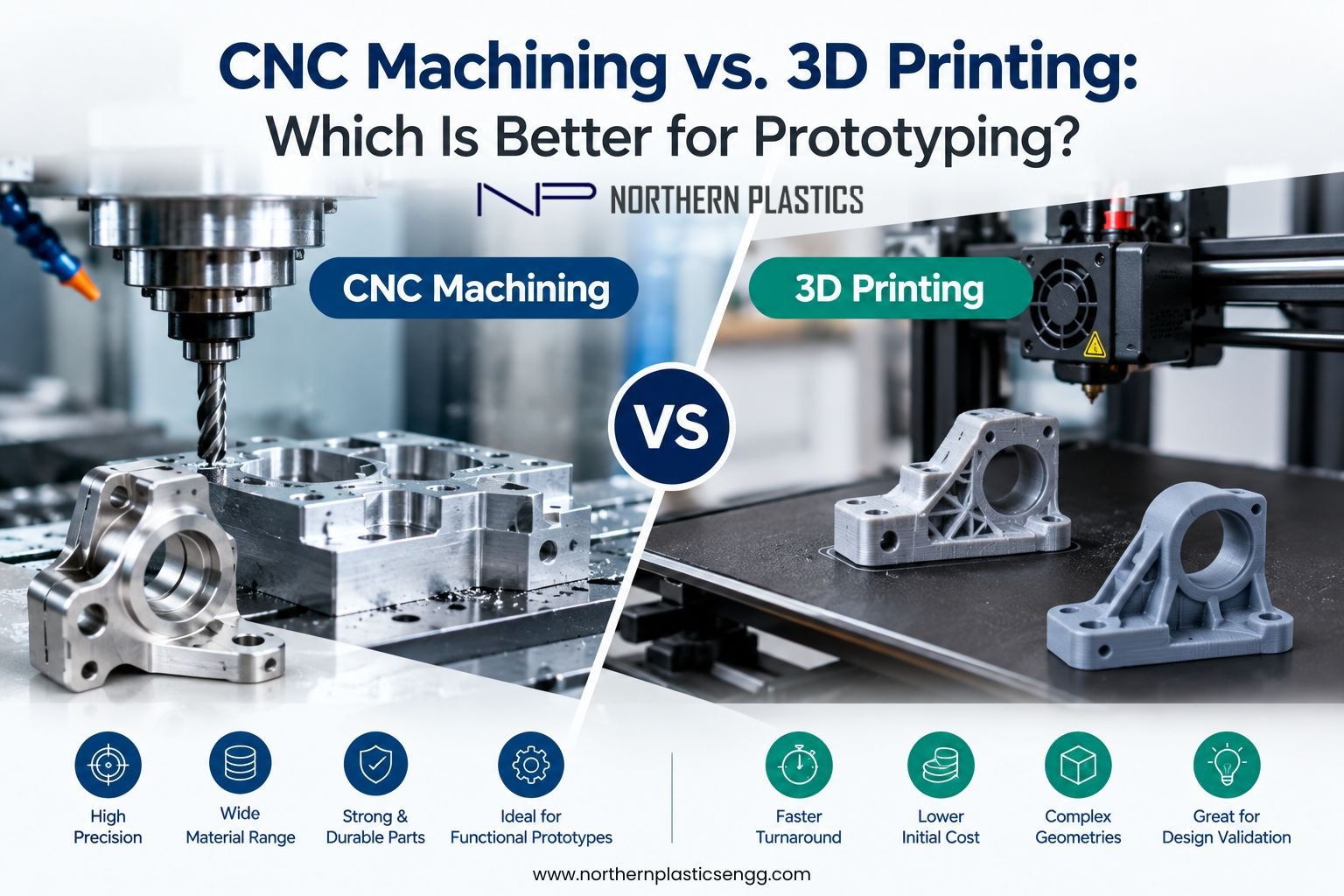
Prototype development is not simply about producing a physical version of a CAD model. For engineering teams, a prototype must validate critical parameters such as dimensional accuracy, material behaviour, assembly fit, surface finish, mechanical performance, and manufacturability before production begins.
CNC machining and 3D printing address these requirements differently. CNC machines from Northern Plastic Engineering use a subtractive process to achieve controlled dimensions from an engineering-grade workpiece, while 3D printing builds the component layer by layer. The right choice depends on what the prototype needs to prove.
CNC Machining vs. 3D Printing: Engineering Comparison –
| Parameter | CNC Machining | 3D Printing |
| Process | Subtractive machining | Additive manufacturing |
| Material selection | Metals and engineering plastics | Primarily polymers/resins; selected metals |
| Dimensional control | High, process-dependent | Technology-dependent |
| Surface finish | Typically superior | Often requires post-processing |
| Mechanical behaviour | Generally more isotropic | Can be direction-dependent |
| Tight tolerances | Well suited | Process/material dependent |
| Complex internal geometry | May require specialised strategies | Generally easier |
| Functional testing | Highly suitable | Suitable for selected applications |
| Design iteration | Moderate | Very fast |
Where CNC Machining Has an Engineering Advantage?
CNC machining is particularly valuable when a prototype must behave similarly to the intended production component. Because the component is machined from a solid billet or workpiece, its material properties are not fundamentally dependent on deposited layers.
This makes CNC machining suitable for prototypes requiring:
- Tight dimensional tolerances and controlled fits
- Functional threads, bores, slots, and mating surfaces
- High-quality surface finishes
- Mechanical load, wear, or thermal testing
- Engineering plastics, aluminium, stainless steel, brass, and other machinable materials
- Verification of assemblies, tooling interfaces, and moving components
Machining strategy, cutter selection, workholding, feeds and speeds, and inspection methods all influence the final result. Therefore, prototype quality depends not only on the CNC equipment but also on process planning and manufacturing expertise.
Where Is 3D Printing More Effective?
3D printing offers a different engineering advantage: rapid design iteration without dedicated tooling. A CAD modification can often be converted into another prototype quickly, making the technology useful during early-stage design development.
It is particularly effective for:
- Form and fit validation
- Complex geometries and lightweight structures
- Rapid concept iterations
- Low-volume visual or functional models
- Components with geometries that would require extensive machining
Nevertheless, engineers should take into consideration various factors such as orientation, build direction, shrinkage in dimensions, surface finish, and anisotropy of materials when using printed parts for testing their functionality.
CNC Machining or 3D Printing – Which One to Select?
Use 3D printing in case rapid iterations and geometric freedom are your top priorities. On the other hand, CNC machining will be a better choice if the prototype should validate the tolerances, strength, finish, and behavior of the material.
In case you need accurate parts and you should rely on their precision to make certain decisions about the tools and manufacturing process, cooperation with professional CNC Machining Manufacturers in India will be a good option.
Precision Prototyping with Northern Plastics Engineering
Northern Plastics Engineering employs a systematic process for CNC Manufacturing that takes into consideration engineering, process control, and quality components. In the case of prototypes and precision machining applications, the manufacturing process should begin with an appreciation of the component geometry, material, tolerances, surface finish, and usage conditions.
Being an expert CNC machining manufacturer in Delhi NCR, Northern Plastics Engineering caters to applications where precision machining and quality components are critical for product development.
Conclusion:
CNC machining and 3D printing complement each other in the process of making prototypes rather than being direct competitors. 3D printing is ideal for making quick iterations and complex designs, but CNC machining is the right approach when production-grade materials are required for the prototype. The right choice will be based on the engineering validation requirements of the prototype.
Frequently Asked Questions:
- Is CNC machining more accurate than 3D printing?
Yes. CNC machining generally provides tighter dimensional control and better surface finish, making it suitable for precision prototypes. - Is CNC machining suitable for plastic prototypes?
Yes. CNC machining can produce prototypes from engineering plastics such as nylon, PEEK, Delrin, and other machinable polymers. - When should I choose 3D printing for prototyping?
3D printing is ideal for rapid design iterations, complex geometries, and early form-and-fit validation. - What should I consider when selecting CNC machining manufacturers in India?
Consider machining capabilities, material expertise, tolerance control, inspection processes, equipment, and experience with precision components.