
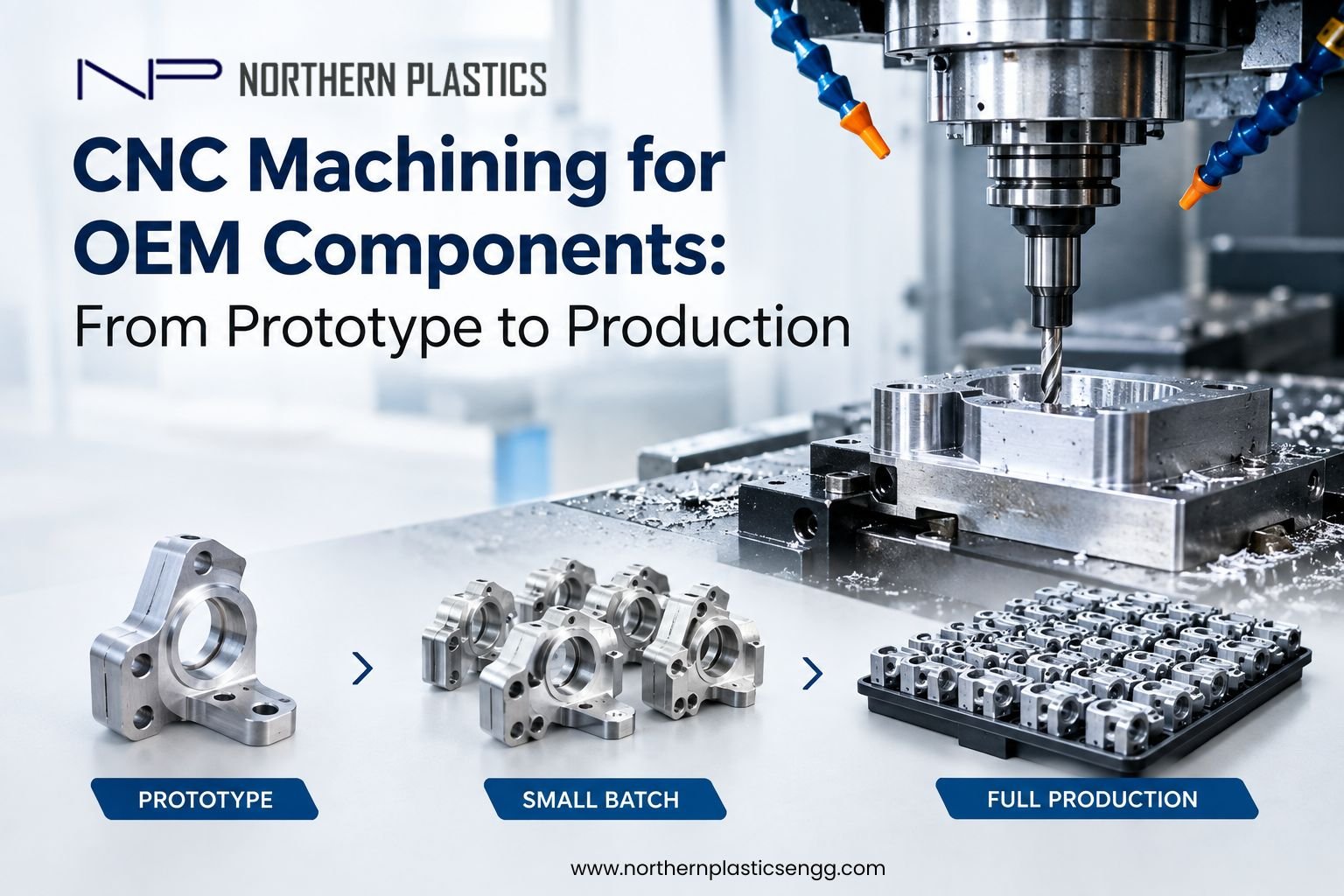
CNC machining assists OEMs in progressing parts from prototype to repeatable manufacturing via CAD/CAM programming, precision machining, process optimization, and inspection. The digital design is perfected in the process of prototyping and then turned into a repeatable manufacturing process for production purposes.
This method allows OEMs to cut the development time without compromising the accuracy and consistency of CNC-machined parts produced by CNC Machining Manufacturers in India such as Northern Plastic Engineering.
How CNC Machining Supports OEM Production?
CNC Machining is often preferred in the fabrication of OEM parts due to its ability to create complicated geometrical shapes within a consistent dimensional tolerance range. This process usually involves the following two main phases:
Phase 1: Prototyping and Verification
- Design for Manufacturability (DFM):
CAD modeling and engineering drawings are examined in terms of their tolerances, wall thickness, hole geometry, datums, materials, and machine capability.
- Functioning Prototype:
The first part is machined using the stated engineering material. It allows OEMs to verify dimensions, fit, assembly, and functional performance before production.
- Low-Volume Production:
Small batches can be manufactured to validate the design under actual operating or assembly conditions without immediately committing to large production volumes.
Phase 2: Scaling to Production
- Process Optimization:
After prototype validation, standardization takes place with respect to machine processes, tooling, work holding, cutting parameters, and inspection processes.
- Pilot Run:
In a controlled production run, one gets a better idea about the problems that may occur in terms of tooling, cycle time, material properties, tolerances, and assembly.
- Mass Production:
With the help of process optimization, mass production is possible with all process parameters and tolerances defined.
What Makes CNC Machining Suitable for OEM Components?
CNC machining offers several production advantages:
- High dimensional repeatability across production batches
- Tight tolerance control for critical mating and functional features
- Flexible material capability, including aluminium, steel, stainless steel, and engineering plastics
- Rapid design modification without creating dedicated moulds or dies
- Consistent production quality through programmed machining processes
- Scalability from prototypes and low-volume batches to regular production
Choosing CNC Machining Manufacturers in Delhi NCR
OEM buyers should evaluate more than the available CNC machines. A competent manufacturing partner would be able to showcase knowledge about engineering drawings, DFM, material selection, process planning, tolerancing, tooling, and dimensional inspection.
It is especially crucial that a manufacturing partner be able to sustain the same standards throughout prototyping and production when manufacturing OEM parts because even minor differences in dimensions can influence assembly and performance.
Conclusion:
With CNC machining, there is a direct pathway of manufacturing processes which starts from
CAD design → prototype → validation → process optimization → pilot manufacturing → mass manufacturing.
For this reason, CNC machining is the ideal choice for OEMs looking for accuracy and repeatability. Northern Plastics Engineering is a renowned manufacturer of CNC machining in Delhi NCR that offers CNC machining services for OEM parts in an engineering way.
Frequently Asked Questions:
- What are the applications of CNC machining in OEM manufacturing?
CNC machining is used for producing accurate prototypes, small batch parts, and repeat-production parts.
- Can CNC machining be applied for prototyping?
Yes. CNC machining can develop functional prototypes using production-grade materials to test their fit, size, and performance.
- How does CNC machining achieve consistency in production?
The use of programmed toolpaths, machining parameters, setup procedures, and dimensional inspection can ensure consistency in production.
- How can I select CNC machining manufacturers in India?
The CNC machine manufacturer should have machining capability, tolerance control, material expertise, quality inspection, and scalability from prototypes to production.