
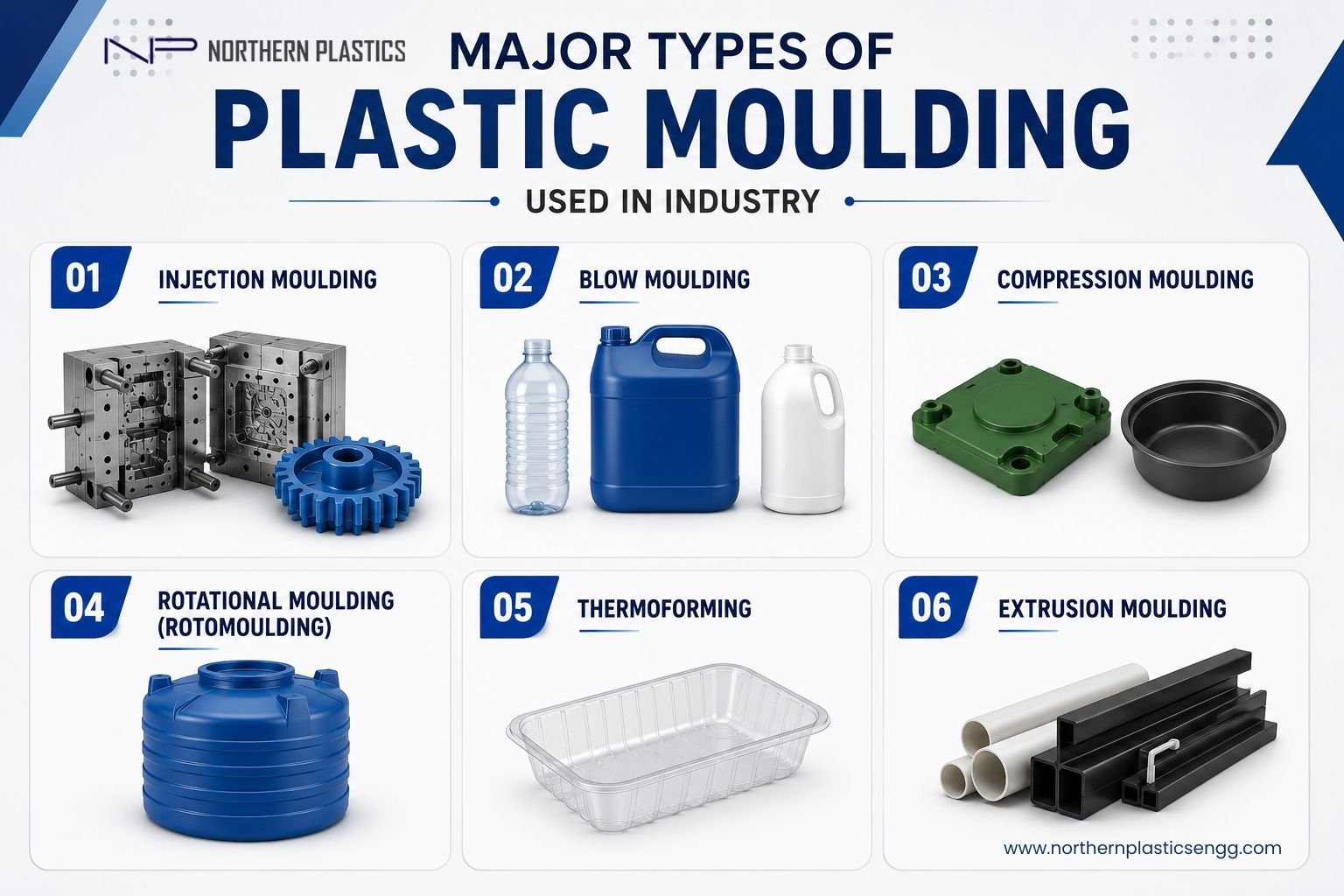
In the world of modern manufacturing, plastic moulding has become a cornerstone for producing durable, high-precision, and cost-effective components across industries — from automotive and electrical to consumer goods and healthcare. But did you know that there are multiple types of plastic moulding techniques, each suited for different applications?
If you’re a product developer, engineer, or manufacturer looking to understand the right plastic moulding process for your requirements, this blog is for you.
Major Types of Plastic Moulding Used in Industry
Injection Moulding
Injection moulding is by far the most widely used plastic moulding process across industries. In this method, melted plastic is injected into a custom-made mould under high pressure. Once the plastic cools and solidifies, the finished product is ejected.
Key Applications | Advantages: |
|
|
At Northern Plastics Engg, we specialize in precision injection moulding, ensuring consistency and quality in every part we deliver.
Blow Moulding
Blow moulding is commonly used for making hollow plastic products. It involves heating plastic and inflating it into a mould cavity, similar to blowing up a balloon.
Key Applications | Types: |
|
|
Blow moulding is particularly advantageous when producing lightweight and uniform hollow parts at high volumes.
Compression Moulding
This process involves placing a pre-heated plastic material into a heated mould cavity. The mould is then closed with pressure to shape the plastic. It is best suited for thermosetting plastics.
Key Applications | Advantages: |
|
|
At Northern Plastics Engg, we can consult you on whether compression moulding suits your product, especially for low-run or cost-sensitive projects.
Rotational Moulding (Rotomoulding)
In rotational moulding, plastic powder is placed into a hollow mould which is then rotated in an oven, allowing the plastic to coat the interior evenly.
Key Applications | Advantages: |
|
|
While it has slower cycle times, rotomoulding offers design freedom and low-cost tooling for larger items.
Thermoforming
Thermoforming involves heating a plastic sheet until it becomes pliable, then forming it over a mould using vacuum or pressure.
Key Applications | Types: |
|
|
Thermoforming is ideal for lightweight packaging and prototypes.
Extrusion Moulding
Extrusion moulding is used to create continuous profiles like tubes, pipes, and sheets. Plastic is melted and forced through a die, shaping it as it cools.
Key Applications | Advantages: |
|
|
How to Choose the Right Plastic Moulding Process?
Choosing the right moulding method depends on several factors:
- Product size and shape
- Volume of production
- Material type
- Tolerance and finish requirements
- Budget and tooling investment
Working with an experienced moulding partner like Northern Plastics Engg ensures that you select the most effective process that balances quality, efficiency, and cost.
Why Choose Northern Plastics Engg?
At Northern Plastics Engg, we bring over two decades of experience in delivering top-quality plastic injection moulds, dies, and mould bases. We cater to diverse industries and provide end-to-end support — from design consultation and prototyping to tooling and final production.
What We Offer:
- High-precision injection moulding
- Custom mould base and die manufacturing
- Rapid prototyping support
- Durable and consistent plastic parts for industrial use
Whether you are a startup launching a new product or an established OEM scaling production, we offer cost-effective and reliable plastic moulding solutions right here in India, USA, UAE, Canada, Turkey, France, Italy, Saudi Arabia, Germany.