
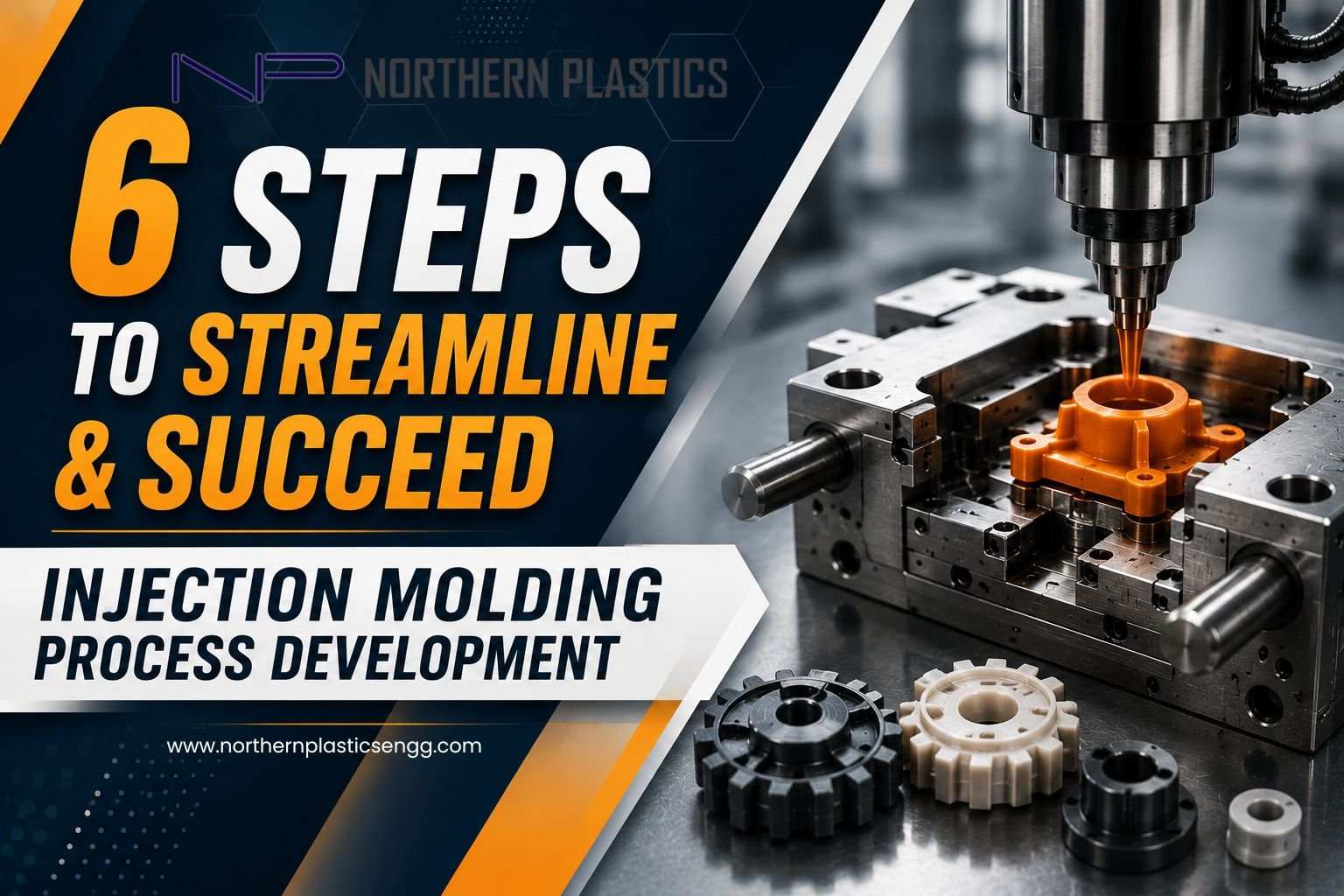
Taking a plastic part from idea to large-scale manufacturing involves far more than just designing a mold and operating the machine. The successful injection molding and new development necessitate engineering skills, material understanding, process enhancement and ongoing validation to ensure that each component fulfills functional, dimensional and commercial standards.
The numerous product development initiatives encounter preventable issues like design changes, tooling setbacks, variable part quality and increased manufacturing expenses. These problems frequently occur when process development is viewed as an isolated task rather than a systematic engineering procedure.
With decades of experience in accurate plastic manufacturing, Northern Plastics Engineering uses a structured development strategy that reduces risks before the start of production. Each phase is aimed at enhancing manufacturability, shortening lead time, and ensuring consistent quality during the product lifecycle.
This guide outlines the six key steps that enhance the efficiency and success of injection moulding process development.
6 Steps to Streamline & Succeed Injection Molding Process Development:
Step 1: Understand the Product Requirement Before Designing the Mould:
Every successful moulding project begins with understanding how the final component will perform. Before any CAD model or mould design starts, engineers evaluate several technical factors:
- Functional purpose of the component
- Mechanical load requirements
- Assembly method
- Operating environment
- Temperature exposure
- Chemical resistance
- Surface finish expectations
- Regulatory requirements
- Production volume targets
A detailed engineering review helps identify potential manufacturing issues early rather than after tooling investment.
Step 2: Perform Design for Manufacturability Analysis
One of the most valuable stages in injection moulding & new development is design for manufacturability. DFM ensures the product design that can be manufactured efficiently without compromising quality or increasing unnecessary tooling costs.
- Wall thickness: A uniform wall thickness improves material flow, minimizes shrinkage variation and shortens cooling time.
- Draft angels: The proper allows smooth part ejection while reducing stress on the mould.
- Rib & boss design: The correct rib proportions increase strength without creating sink marks.
- Gate Position: Selecting the right gate location improves filing balance and reduces weld lines.
- Undercuts: By reducing unnecessary undercuts simplifies mould construction and lowers tooling cost.
- Material Flow Analysis: Simulation software predicts filling patterns, air traps, weld lines & pressure distribution before manufacturing begins.
Step 3: Select the Right Plastic Material for Performance & Production
Material selection influences nearly every aspect of injection molding performance. The same component may require different engineering plastics depending on the application. The selection depends on:
- Mechanical strength
- Flexibility
- Wear resistance
- Chemical compatibility
- Heat resistance
- UV stability
- Electrical insulation
- Food-grade compliance
Experienced process engineers also consider how the selected polymer behaves during moulding. The factors such as:
- Melt flow index
- Shrinkage taste
- Moisture absorption
- Processing temperature
- Cooling characteristics
Step 4: Develop a Precision Mould That Support Long-Term production:
The mould is the foundation of every injection moulding project. Even a perfectly designed plastic component cannot consistently achieve dimensional accuracy if the mould itself lacks accuracy.
- Proper cooling channel design: Efficient cooling reduces cycle time while maintaining dimensional consistency.
- Balanced runner system: Balanced flow ensures uniform cavity filling across multi-cavity moulds
- Venting Design: The proper venting prevents burn marks, trapped games and incomplete filling.
- Ejection System: A well-designed ejector mechanism reduces part deformation and improves repeatability.
Step 5: Validate the Process Before Full-Scale Production:
The process validation confirms that both the mold and the manufacturing process consistently produce parts within specification. Instead of immediately moving into production, experienced manufacturers conduct structured validation. The typical validation activities include:
- Tool trials
- First article inspection
- Dimensional verification
- Process capability analysis
- Material performance checks
- Cooling optimization
The critical process parameters are established, by including:
- Injection pressure
- Holding pressure
- Injection speed
- Melt temperature
- Cooling time
- Cycle time
Step 6: Continuously Improve Production Performance:
The process development does not end after production approval. The continuous monitoring helps in maintaining product consistency while improving the operational efficiency over time. The manufacturers regularly monitor:
- Cycle time trends
- Part weight consistency
- Rejection rates
- Machine uses
- Tool wear
- Dimensional stability
The production data provides valuable insights for identifying opportunities to:
- Reduce material waste
- Improve productivity
- Increase machine efficiency
- Less manufacturing costs
Common Challenges During Injection Moulding Process Development:
A well-planned project can also have some technical challenges. Some of the most common challenges include:
| Challenge | Engineering Solution |
| Warpage | Optimize cooling system, wall thickness and packing pressure |
| Sink Marks | Improve rib design and maintain uniform |
| Flash | Fine-tune clamping force and maintain mould alignment |
| Short shots | Optimize gate design, venting and injection parameters |
| Weld line | Improve gate location and material flow balance |
Why Choose Northern Plastic Engineering for Injection Moulding & New Development?
At Northern Plastics Engineering, process development relies on engineering accuracy, manufacturing knowledge, and a dedication to enduring product success—not merely the completion of tooling. With years of experience in precision plastic injection moulding, the team works closely with clients from idea to production to guarantee that each part is refined for performance, manufacturability, and cost-effectiveness.
- Years of experience in accurate plastic injection moulding
- In-depth design for manufacturability analysis
- Advanced mould development with accurate engineering
- Consistent manufacturing backed by proven engineering practices
- Customer-centric approach with transparent project communication
Best Injection Moulding & New Development – Northern Plastic Engineering:
An effective Injection Moulding & New Development process involves more than just crafting moulds—it necessitates careful planning, exact engineering, and ongoing enhancement. By adhering to a systematic development method, manufacturers can minimize production risks, enhance product quality, and attain uniform outcomes. Leveraging vast industry knowledge, Northern Plastics Engineering assists in turning creative product ideas into dependable, top-tier plastic parts prepared for large-scale manufacturing.